hacking
Doublespeed promised total automation. A hacker found 1,100 phones and an unpatched door.
A hacker breach reveals the $1M 'AI innovation' behind Doublespeed is actually 1,100 physical phones and a lot of unpatched security holes. Read the post-mortem.
The marketing copy for Doublespeed, a prominent graduate of the a16z Speedrun accelerator, reads like a manifesto for the post-labor economy. According to official promotional materials, the startup offers a novel shift in content creation that allows a single user to "orchestrate what used to take a 30-person creator team and $40,000 at 10% of the cost" a16z Speedrun. In the venture capital logic of 2025, "orchestration" is a polite euphemism for the replacement of human creative labor with autonomous agentic workflows. Investors were told they were funding a high-margin software play that used proprietary systems to conquer social media. The reality, documented in late 2025 and finalized by a humiliating secondary breach in April 2026, involves significantly less proprietary code and significantly more lithium-ion batteries.
The Doublespeed incident demonstrates that current 'AI influencer' ventures are frequently physical bot-nets in disguise, whose reliance on hardware-based platform evasion—rather than algorithmic innovation—creates unmanageable security liabilities and systemic ethical risks that venture capital firms are neglecting to audit. When the "orchestration" layer was peeled back by an anonymous hacker, it revealed not a sleek server farm of GPU clusters, but a "Phone Farm"—a cluster of hundreds or thousands of physical mobile devices connected to a central management system to simulate human activity at scale on mobile apps. By tethering synthetic personas to physical hardware, Doublespeed attempted to bypass TikTok’s bot detection, but in doing so, they built a massive, unmonitored attack surface that eventually turned their own "Synthetic Influencers" against their backers. The vulnerability of this model lies in its centralized physical nature, which exposes the entire network to any attacker who finds a single entry point into the control software.
The Glass House of Synthetic Influencers
The scale of the Doublespeed operation first came to light in December 2025, when a hacker successfully bypassed the startup’s backend security. Unlike most "AI" hacks, which involve prompt injection or model weight theft, this breach was fundamentally about infrastructure. The hacker didn't just find code; they found a control panel for a massive physical operation. According to documentation provided to journalists, the intruder gained full access to the device managers, proxy passwords, and account assignments for over 1,100 physical smartphones 404 Media.
"I can see the phones in use, which manager [computers controlling the phones] they had, which TikTok accounts they were assigned, proxies in use (and their passwords), and pending tasks," the anonymous hacker stated during the initial revelation 404 Media. This wasn't a virtualized cloud environment. This was "Astroturfing as a Service"—a business model that provides clients with seemingly organic but centrally controlled synthetic engagement and promotion—running on physical hardware to trick platform algorithms into seeing "human" device IDs and SIM signatures. The hardware consisted primarily of second-hand iPhones and Android devices, stripped of their cases and mounted on industrial metal racks.
The breach exposed the existence of over 400 "Synthetic Influencers," AI-generated personas used for social media marketing that lack a corresponding real-world human identity. Among the most prolific was "Chloe Davis," a synthetic persona that had successfully integrated into the fitness and wellness niche. Logs revealed that Chloe Davis alone had posted approximately 200 videos hawking a massage roller for the brand 'Vibit' 404 Media. These videos used AI-generated footage and voices, but they were uploaded and managed by the physical devices in the farm to maintain the illusion of a legitimate, mobile-first creator.
The vulnerability that allowed this access was reportedly an unauthenticated backend endpoint that exposed the internal database of device statuses and credentials. In the rush to scale, the basic security hygiene of "not leaving the front door unlocked" was discarded.
The discovery of this infrastructure highlights the central deception of the "AI influencer" era. While the public and investors are sold on the "intelligence" of the agents, the actual competitive advantage is the hardware-enabled evasion of platform security. This creates a precarious engineering environment where the "orchestration" is actually just a glorified remote-desktop protocol for a room full of overheating iPhones. The 1,100 devices represented a single point of failure for a network supposedly built for decentralized scale.
Five Months of Institutional Silence
The fallout from the Doublespeed breach was not an explosive, one-day event, but a slow-motion collapse characterized by a total failure of corporate and investor accountability. The timeline suggests that for the better part of half a year, both the startup and its venture capital backers were aware of the rot and chose to hope the internet wouldn't notice. This period of Institutional Silence allowed the vulnerability to persist, ultimately leading to the more damaging events of early 2026.
- October 31, 2025: The First Warning. An anonymous hacker discovers an unpatched vulnerability in the Doublespeed backend. The hacker reportedly attempts to notify the company, providing evidence of the exposed 1,100-device farm and the credentials for the account managers. The report is met with silence. No patch is issued. No disclosure is made to the brands whose accounts were managed via the compromised farm 404 Media.
- December 17, 2025: The Public Revelation. Major tech outlets, including 404 Media and Futurism, publish investigative reports detailing the breach and the existence of the phone farm. The reports link Doublespeed to a16z Speedrun and document the mass distribution of undisclosed advertisements Futurism.
- January – March 2026: The Ghosting Period. Despite the public exposure of their infrastructure, Doublespeed fails to respond to journalists, the FTC, or their own users. The company remains in a state of silence, neither confirming a patch nor shuttering the farm. Internal logs later suggested that the devices continued to operate, pumping out content for minor wellness brands throughout the first quarter.
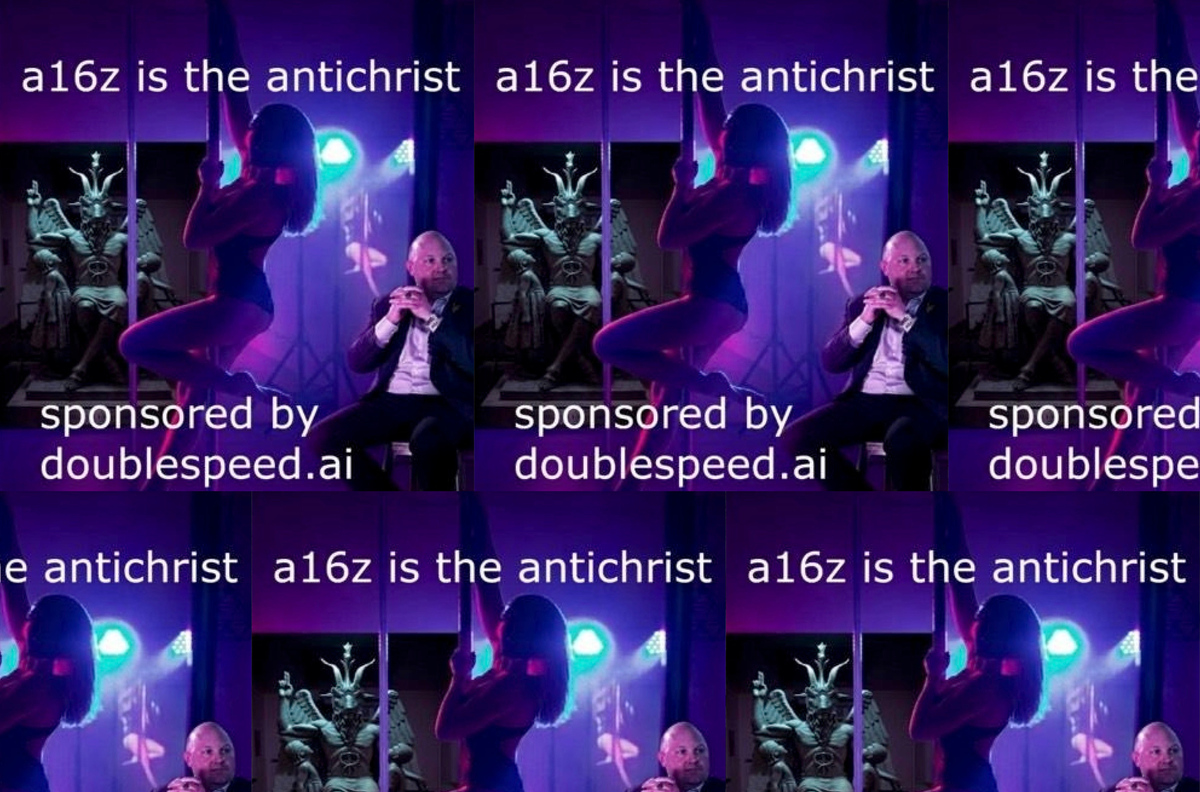
- April 14, 2026: The 'Antichrist' Campaign. The consequences of the unpatched security holes finally reach their logical, surreal conclusion. Hackers—presumably utilizing the same backend access that had been open since October—seize control of the synthetic influencer accounts. Instead of hawking massage rollers, the 400+ accounts begin a synchronized campaign posting anti-VC memes, specifically labeling a16z the "Antichrist" Phemex.

The April breach represents a unique failure of the "keys to the kingdom" model. By centralizing the management of 400+ distinct identities onto a single physical farm with a poorly secured backend, Doublespeed created a "God Mode" for any attacker. When the hackers shifted from investigation to activism, they demonstrated that an "AI Influencer" is only as autonomous as the security of its USB hub. The Antichrist campaign went viral specifically because the infrastructure allowed for perfect, frame-perfect synchronization across hundreds of high-authority accounts.
Technical Root Cause: Innovation as Evasion
To understand why Doublespeed failed, one must understand why they built a physical phone farm in the first place. On a technical level, TikTok and other social platforms have become highly adept at detecting emulated mobile environments. If you try to run 400 instances of a TikTok bot on a cloud server in Virginia, the platform’s security algorithms will flag the data center IP, the lack of hardware sensor data (accelerometer, gyroscope), and the missing cellular handshake. Platforms explicitly ban such "coordinated inauthentic behavior" to maintain user trust TikTok Integrity.
The "innovation" at Doublespeed was not an LLM advance; it was the realization that physical hardware is the ultimate proxy. By using a Phone Farm—1,100 real devices with real components—they could provide the platform with the telemetry it expected. This allowed them to conduct industrial-scale "Astroturfing as a Service" while appearing as hundreds of individual, organic users. Each device was assigned a dedicated proxy and a unique SIM profile, making the traffic indistinguishable from a standard residential user at the network layer.
The term "Phone Farm" has traditionally been associated with "click farms" in Southeast Asia. Doublespeed’s "innovation" was to move this infrastructure into the VC-backed San Francisco ecosystem, branding it as "AI orchestration" to secure a $1 million+ investment a16z Speedrun.
The root cause of the security failure is rooted in the "Speedrun" culture itself. When the primary metric for success is "growth at all costs" and the time-to-market is measured in weeks, security is viewed as a friction point. Hardcoded credentials, exposed logs, and unauthenticated endpoints are the standard wreckage of a startup trying to "orchestrate" before it can even "authenticate." The Speedrun FAQ emphasizes rapid prototyping and "building in public," but it often neglects the rigorous auditing required for hardware-integrated systems Speedrun FAQ.
There is an inherent conflict between the goals of "orchestration" and the reality of "spam." If your business model relies on circumventing a platform's Terms of Service, your engineering will naturally prioritize evasion over integrity. You cannot build a secure house on a foundation of deception. The reliance on physical hardware creates a massive physical attack surface that cannot be patched with a simple software update if the underlying control logic is fundamentally flawed.
The Pitch for Democratization
Defenders of Doublespeed and the broader a16z "Speedrun" philosophy argue that the focus on the phone farm's physicality misses the larger technological achievement. They contend that "orchestration" is a legitimate advance that democratizes content creation, allowing individual entrepreneurs to compete with the 30-person production teams of legacy media companies at 10% of the cost a16z Speedrun. From this perspective, the phone farm is merely an "implementation detail"—a temporary bridge until platforms provide official APIs for synthetic media. They argue that this follows the established "AI platform stack" where hardware often precedes software refinement a16z AI Stack.
However, democratization implies transparency and agency, two things conspicuously absent from the Doublespeed model. The evidence of 1,100 physical phones used specifically to circumvent platform security—combined with the mass distribution of undisclosed ads for products like massage rollers and supplements—indicates a factory for industrial-scale deception rather than a tool for individual empowerment. There is a vast difference between empowering a creator and automating a bot-net to mimic one.
Authenticity is the currency of the influencer economy. By flooding the zone with personas like "Chloe Davis" without disclosing their synthetic nature or their centralized control, Doublespeed wasn't democratizing the creator economy; they were devaluing it. As the hacker proved, when you "democratize" content by automating it through a room full of phones, you aren't empowering creators—you're just building a bigger, more fragile megaphone for spam. The devaluation of authenticity is a systemic risk that threatens the economic viability of real human creators.
FTC Violations and Reputational Decay
The consequences of the Doublespeed breach extend far beyond the startup’s balance sheet. The exposure of the 400+ TikTok accounts revealed a massive disclosure gap in the synthetic media space. According to investigative reports, the majority of these accounts failed to provide mandatory ad disclosures for the products they promoted Futurism. This failure directly violates the federal mandate for "clear and conspicuous" disclosure of paid endorsements FTC Disclosures.
The FTC has clear guidelines regarding "clear and conspicuous" disclosures for influencers. However, these rules assume a human actor who can be held accountable. When the "influencer" is a Synthetic Persona managed by a Phone Farm, the accountability chain vanishes into a cloud of proxies. This creates a regulatory vacuum where synthetic actors can operate with impunity until a catastrophic breach occurs.
- Disclosure Failure: Over 400 accounts were identified promoting supplements and wellness gadgets without #ad or #sponsored tags. This lack of transparency undermines the trust necessary for a functional marketplace.
- Platform Integrity: Despite TikTok's claims of advanced bot detection, 1,100 physical phones were able to operate undetected for months, proving that hardware-based evasion is a viable threat to platform authenticity.
- Brand Liability: Brands like Vibit, which utilized the synthetic "Chloe Davis," now face a "keys to the kingdom" risk. When the infrastructure managing their "brand ambassador" is hacked, their brand becomes the vehicle for whatever messages the attacker chooses.

The most significant reputational damage, however, has been reserved for the investors. The April 2026 meme campaign, where compromised accounts were used to target a16z directly, served as a visceral reminder of the risks of funding "black box" orchestration startups. When the "Antichrist" memes began trending, it wasn't just a hack; it was a performance piece on the volatility of synthetic influence. The Antichrist campaign highlighted the irony of a venture firm being attacked by the very "agentic workflows" it sought to fund.
The High Cost of Cheap Content
The Doublespeed incident draws uncomfortable parallels with other recent "AI" failures. We have seen AI surveillance startups caught using sweatshop labor to manually tag data while claiming their models were fully autonomous. We have seen "AI" customer service bots that were actually just humans in low-wage markets typing into a chat interface. Doublespeed represents the hardware version of this trend, shifting from software innovation to hardware-enabled deception.
By funding physical spam farms under the guise of "AI," venture capital firms are creating a more fragile and deceptive internet. The precedent set here is one of institutional negligence. If a startup can receive $1 million in funding for a physical bot-net without undergoing a rigorous security or ethical audit, then the "Speedrun" model is fundamentally broken. The high cost of "cheap" content is the erosion of the very platform integrity that makes that content valuable in the first place.
The reliance on a physical Phone Farm was a deliberate engineering choice to bypass the authenticity checks of social media platforms. This choice created a massive, centralized point of failure that was exploited twice—first to expose the deception, and second to humiliate the backers. The "orchestration" layer was nothing more than a thin software veneer over industrial-scale astroturfing. The evidence supports the thesis that current 'AI influencer' ventures are often just physical bot-nets, and the security liabilities they create are indeed unmanageable within the current VC funding framework.
Venture capital firms have shown a persistent inability to audit the technical reality of the "AI" they fund. As long as "10x cost reduction" remains the only metric that matters, we will continue to see "innovations" that are just rooms full of smartphones and unpatched doors. The Doublespeed post-mortem suggests that if you want to find the future of AI, you shouldn't look at the models. You should look at the USB cables. The analytical verdict is clear: the industry is currently prioritizing the appearance of automation over the reality of secure, ethical software engineering.