ai-bubble
Tech giants are spending $1 trillion on AI infrastructure. Wall Street is asking where the money is.
Tech giants are pouring $1 trillion into AI infrastructure, but with a $600 billion revenue gap and massive losses, Wall Street is asking when the bubble pops.
Tech giants are currently engaged in a historic infrastructure arms race, purchasing GPUs and building data centers at a pace not seen since the dot-com fiber glut. However, as leaked financial documents reveal billions in projected losses for industry darlings like OpenAI, Wall Street analysts are beginning to publicly question the math, shifting the narrative from unbridled optimism to warnings of an imminent tech bubble.
The current capital expenditure on generative AI infrastructure by major tech companies vastly exceeds the revenue generated by the technology. This dynamic creates a $600 billion structural deficit that cannot be resolved without either an unprecedented, immediate explosion in software revenue or a severe market valuation correction.
The $1 Trillion Infrastructure Bet
The sheer scale of the financial commitment to generative AI is immense, yet the returns remain stubbornly disproportionate. The industry operates on a model of massive CapEx (Capital Expenditure) — funds used by a company to acquire, upgrade, and maintain physical assets. In the AI context, this primarily means purchasing GPUs, cooling systems, and data center real estate. According to a June 2024 report by Goldman Sachs, tech giants and other investors are projected to spend approximately $1 trillion on AI CapEx in the coming years.
A significant portion of this spending is driven by GPU Stockpiling. This is the practice of tech companies buying and hoarding advanced graphics processing units, like Nvidia's chips, to secure future computing capacity regardless of immediate end-user demand. While AI hardware supply shortages largely subsided by mid-2024, major cloud providers have continued to drive the vast majority of Nvidia's data center revenue. This concentration of spending among a few hyperscalers contributes to fears of systemic over-purchasing.
The disconnect between spending and earning is starkly illustrated by OpenAI, the poster child of the generative AI boom. Despite reportedly generating $300 million in revenue in August 2024 — representing a 1,700% increase since early 2023, according to CNBC — the company remains deeply unprofitable. A financial leak revealed that OpenAI expects to lose roughly $5 billion in 2024 against $3.7 billion in revenue. This deficit is driven heavily by the costs of computing and staffing, according to CNBC.
OpenAI's massive burn rate complicates the narrative of its reported $150 billion valuation (CNBC), raising serious questions about the long-term profitability of foundational large language models.
Wall Street Wakes Up to the Math
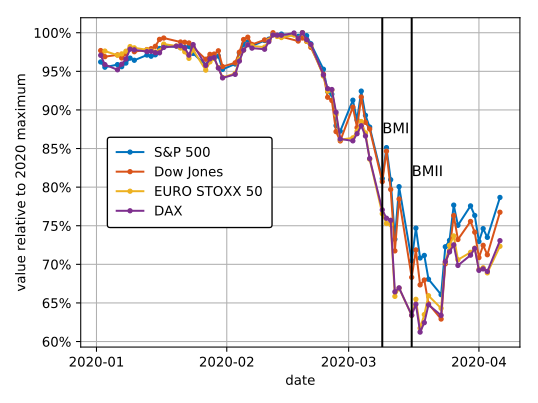
Financial institutions, previously happy to ride the wave of AI enthusiasm, are beginning to crunch the numbers and balk at the results. The sentiment is shifting rapidly from speculative frenzy to fundamental skepticism as analysts review the quarterly capital expenditure reports.
In June 2024, David Cahn, a partner at Sequoia Capital, published an analysis calculating a massive disconnect between infrastructure costs and the software ecosystem's earnings. Cahn factored in Nvidia's revenue run-rate, added the cost of energy and data center margins, and compared that figure to the actual revenue the AI ecosystem is currently generating. He identified a $600 billion gap between the expected revenue implied by AI infrastructure build-outs and real consumer spending, concluding that "the AI bubble is reaching a tipping point" at Sequoia Capital.
Similarly, Jim Covello, Head of Global Equity Research at Goldman Sachs, pointedly asked, "What $1 trillion problem will AI solve?" in his firm's comprehensive report questioning the economic viability of generative AI. Covello argued that AI technology is exceptionally expensive and has not yet demonstrated the ability to solve complex problems that would justify its cost.
The historical parallels are difficult to ignore. The situation bears a striking resemblance to the dot-com crash of 2000, where massive physical infrastructure was built far ahead of actual consumer demand or practical business models. Companies went bankrupt after laying thousands of miles of undersea cables that no one needed yet [source needed]. Just as the fiber glut led to a temporary collapse of tech valuations, the current GPU stockpiling frenzy suggests a market that has priced in a future taking years to materialize.
The 'Normal Innovation Phase' Defense
Defenders of the current spending spree argue that this level of investment is necessary, expected, and historically sound. The opposing view suggests that high CapEx is normal for new transformative technologies; the infrastructure will eventually become a commodity, reducing prices and ultimately sparking an explosion of software-level innovation and start-ups. From this perspective, the current spending is merely the table stakes required to build the foundation of the computing industry's next phase.
Proponents point to the early days of cloud computing, where platforms required massive capital expenditure before becoming highly profitable. The expectation is that AI infrastructure will follow a similar curve. As more compute comes online, the cost of intelligence will ostensibly drop, enabling applications we cannot yet imagine.
However, while infrastructure commoditization lowers long-term costs, the current valuations of AI companies assume immediate, massive software revenue that does not yet exist. Relying on Run-rate Revenue — a method of estimating a company's upcoming annual revenue based on past or current financial performance — paints a picture of growth, but it fails to cover the staggering upfront costs. This makes the short-term financial math unsustainable and highly vulnerable to a market crash before that anticipated innovation phase can arrive, a structural deficit documented extensively by skeptics at Sequoia Capital.
The Existential FOMO Justification
Faced with these glaring financial disparities, tech leaders have adopted a unified defense: existential fear of missing out, or FOMO. They are justifying the continued massive capital burn rate to investors by positioning over-spending as a strategic necessity rather than a financial miscalculation.
During Alphabet's Q2 2024 Earnings Call, CEO Sundar Pichai argued that "the risk of underinvesting is dramatically greater than the risk of overinvesting" [source needed]. Pichai maintained that even if the AI hype cools, the data centers being built are highly flexible and can be repurposed for traditional cloud computing workloads.
Meta's leadership has echoed similar sentiments, stating that the capital required to train future models is so vast that companies must start building the compute clusters years in advance [source needed]. The logic is that falling behind in the foundational AI race is an existential threat to their core businesses, making short-term financial losses an acceptable price to pay for long-term relevance.
Yet, this strategy hinges entirely on the eventual discovery of a highly profitable application that can justify a trillion-dollar infrastructure bill. Until such an application emerges, the broader tech market remains at severe risk if these infrastructure investments fail to yield proportionate software revenue.
The Inevitable Market Correction
The generative AI industry is currently operating on a speculative financial model where a trillion dollars in infrastructure is being built for software revenue that does not yet exist. We stated at the outset that the current capital expenditure on generative AI infrastructure by major tech companies vastly exceeds the revenue generated by the technology. This creates a $600 billion structural deficit that cannot be resolved without either an unprecedented explosion in software revenue or a severe market valuation correction.
The evidence — from OpenAI's projected $5 billion loss reported by CNBC, to the $1 trillion CapEx estimate by Goldman Sachs, and the $600 billion revenue gap identified by Sequoia Capital — strongly supports this thesis. The industry is stockpiling GPUs and building data centers at a rate completely detached from current earning realities. If a massively profitable commercial application does not materialize quickly to balance the ledgers, the math dictates an inevitable market correction.